
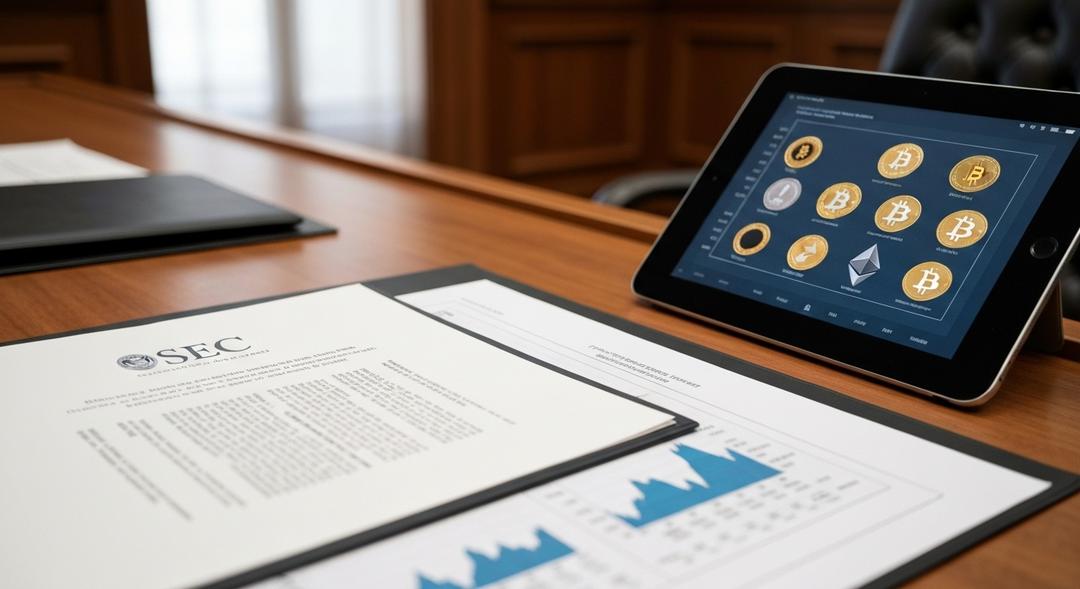
The Securities and Exchange Commission has quickly changed its stance today. The SEC now allows faster approval of cryptocurrency-related exchange-traded funds.
As a result, crypto ETF issuers are no longer required to submit the once crucial 19b-4 forms. This new regulatory development marks a significant departure from previous procedures, which typically delayed new spot crypto ETFs from reaching investors.
In the past, launching a crypto ETF required exchanges to coordinate with issuers on an arduous process. The 19b-4 filings had to be submitted along with an S-1 document outlining the ETF’s structure and purpose.
Traditionally, the SEC treated each new digital asset ETF as a special case, studying the merits of each proposal separately.
Earlier this month, the SEC introduced generic standards for listing exchange-traded products tied to commodities, including cryptocurrencies. Exchanges now gain the ability to list eligible crypto funds automatically as long as the product fits well-established rules.
Applications for commodities like Solana, Litecoin, and Dogecoin were already in progress when these changes emerged. Under the previous system, every product proposal involved both the exchange and the SEC, adding months of review time.
By removing the need for specific 19b-4 forms, the approval process becomes significantly quicker. The only requirement now is submitting an S-1, which still allows the SEC to review the ETF’s details.
Industry observers say this shift demonstrates how rapidly the SEC can move if there is motivation. Some speculate that new approvals could happen within days, which contrasts with the lengthy wait times that have dogged crypto ETF issuers before.
There are still questions about how the SEC will prioritize outstanding S-1 filings. The outcome might hinge on which issuer filed first, as the agency sometimes observes a first-come, first-served policy.
Analysts suggest there could be either a cascade of new ETF launches in quick succession, or perhaps a staggered sequence, depending on the SEC’s internal processes.
This regulatory overhaul is expected to help mainstream financial institutions embrace new crypto investment products with less bureaucratic friction. In the past, delays and repeated requests for more information slowed market innovation.
The change opens the door to a more dynamic crypto ETF marketplace, one where exchanges and asset managers can respond swiftly to investor demand.
Although the fast track process now clears urgent regulatory bottlenecks, uncertainty remains. Factors unrelated to market structure, such as government shutdowns, could introduce fresh delays.
However, by lowering barriers to entry, the SEC’s amended rules may soon allow millions of investors seamless access to a broader range of digital assets through approved funds.
Those looking to capitalize on the institutional shift toward digital asset adoption may benefit from learning how to Start Cloud Mining as new opportunities arise alongside ETF developments.
Some experts believe that this new SEC approach will fundamentally alter the pace and scale at which digital asset products enter the marketplace, signaling a broader change in financial market innovation.
With the SEC’s updated stance, the narrative around cryptocurrencies in the regulated financial sector is rapidly evolving.
Conclusion
The SEC’s decision to drop the 19b-4 requirement for crypto ETFs represents a striking break from the agency’s usual approach. The industry may see the launch of new spot crypto ETFs in record time, as asset managers and exchanges can act with greater agility.
As new crypto funds move from proposal to market more swiftly, this evolving landscape could influence how investors, asset managers, and regulators adapt to the next chapter of digital finance. The coming months will reveal how these reforms shape the opportunities and access available to participants in the growing crypto asset space.

Ewan’s fascination with cryptocurrency started through his curiosity about innovative technologies reshaping the financial world. Over the past four years, he has specialized in cloud mining and crypto asset management, diving deep into mining contracts, profitability analysis, and emerging trends. Ewan is dedicated to helping readers understand the technical and economic aspects of crypto mining, making complex information accessible and actionable.